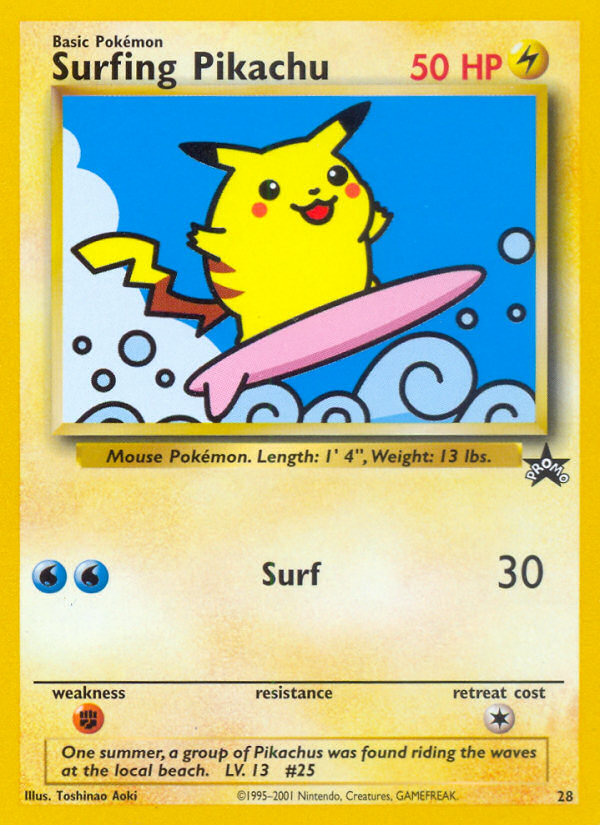
Surfing Pikachu
- Number
- 28
- Rarity
- Promo
- Generation
- Generation 1 (Kanto)
- Era
- Base era (1999)The original Wizards of the Coast run — the most collected and the most counterfeited era.
- Card type
- Pokémon
- Subtype
- Basic
- HP
- 50
- Energy type
- Lightning
- Level
- 32
- Retreat cost
- 1
- Weakness
- Fighting ×2
- Illustrator
- Toshinao Aoki
Attacks
Surf — 30
Cost: Water, Water
One summer, a group of Pikachus was found riding the waves at the local beach.
Where to buy
These take you to third-party marketplaces. Pocket Deckers doesn't sell cards and isn't party to any purchase you make there.
Price range
What copies are listed for on third-party marketplaces, in their own currencies. Not a valuation, and not a price on Pocket Deckers.
- Normal
- US$45.00 – US$529.27recent sales avg US$70.19
- Cardmarket trend
- €55.56
As of 2026-08-17
Is it real or fake?
Surfing Pikachu is among the most frequently counterfeited cards. The card-specific guidance below matters more here than the general checks.
Pikachu — authentication notesOne of the most forged characters in the hobby — and the subject of its most famous counterfeit.
Why Pikachu
In a 2025 review of the characters appearing most often on counterfeit trading cards, six of the top ten were Pokémon — Charizard, Pikachu, Gengar, Rayquaza, Umbreon and Mewtwo. Pikachu is forged across every era, from Base Set through to modern promos, because there is always a valuable Pikachu somewhere.
Pikachu Illustrator
The 1998 Pikachu Illustrator is among the most valuable cards in existence and has been counterfeited to a very high standard. CGC's published examination of one found tells that only appear on direct comparison:
- The artwork sits lower on the counterfeit — Pikachu's paintbrush does not quite reach the top of the art box
- Under infrared, details such as the torch react differently: lines visible on the fake are absent on the genuine card
- The holofoil area appears grey and washed out on the counterfeit, where the genuine card is darker with a more visible holo pattern
Two of those three require equipment. That is the honest state of this card: it is not authenticated by eye.
For any valuable Pikachu
Buy it graded and verify the certification number on the grading company's own website, checking that the card in the slab matches the photo on file. Counterfeit slabs exist as well as counterfeit cards.
Authenticating Base, Gym, Neo, E-Card cardsThe 1999–2003 Wizards of the Coast era — the most forged years in the hobby.
Why this era is different
Wizards of the Coast printed these between 1999 and 2003, and they carry most of the hobby's money — which is why they carry most of its counterfeits. They also predate every texture and foil trick used on modern cards, so the checks that matter here are about print quality and card stock, not surface feel.
Print runs you can tell apart
Base Set exists in three runs, and they are visually distinguishable:
- 1st Edition — the 1st Edition stamp, and no drop shadow on the right of the artwork box
- Shadowless — no stamp, no shadow
- Unlimited — the drop shadow is present
A 1st Edition stamp together with a drop shadow is a contradiction on Base Set and indicates a fake. Check the stamp itself too: forged stamps are commonly the wrong size, wrongly placed, or too heavy.
The holo pattern
Genuine holos from this era use a "galaxy" pattern — stars in a fluid rainbow that shifts naturally as the card tilts. Counterfeits frequently show straight lines instead of stars, a mirror-like shine, or a reflection that stays static as you change the angle.
The tiny copyright line
The bottom-of-card copyright text is where reproductions fail first. It is small enough that a scan-and-reprint smudges it while the artwork still looks fine. Under magnification it should be crisp at that size.
A false positive worth knowing
Cards from this era are frequently miscut or badly centred from the factory. That is a condition issue, not evidence of forgery. Judge the print quality and the card's layers, never the alignment.
How to tell a real Pokémon card from a fakeNine non-destructive checks, what each one actually proves, and where each one is wrong.
Read this first
No single check proves a card is real. Every test below has a way of being wrong in both directions: genuine cards that fail it, and counterfeits that pass. Treat them as evidence that accumulates, not as a verdict.
If a card is worth enough that being wrong would hurt, send it to a grading service. That is the only answer that comes with a guarantee.
1. The light test — useful, and the most over-trusted
Hold the card against a bright light and look through the short edge. A genuine modern English card has an opaque dark inner layer and blocks most light. A cheap counterfeit glows, often with the print showing through from the other side.
Where it is wrong, in both directions:
- Genuine cards that fail it. Older Japanese cards use thinner stock and can transmit noticeable light. Textured Special Illustration Rares and POP Series cards behave differently too.
- Fakes that pass it. Modern counterfeits are now made with a dark inner layer specifically to defeat this test. Passing the light test tells you a card is not a cheap fake. It does not tell you the card is real.
2. Print pattern under magnification — the strongest single check
Genuine cards are offset-printed in CMYK, so even flat colour resolves under magnification into a regular repeating pattern of tiny cyan, magenta, yellow and black dots — a rosette. A 10× jeweller's loupe is enough to see it; 30× or more is better.
- Genuine: tiny, round, evenly spaced dots in a consistent rosette.
- Inkjet fake: irregular, elongated dots, or a chaotic spray.
- Laser fake: toner clumping with melted-looking edges.
- Scanned fake: blocky pixel edges, or flat solid colour with no dot structure at all.
This is harder to fake than the light test because it is a property of the printing process rather than of the materials.
3. Texture and surface
Run a fingertip over the card. Genuine cards have a subtle, consistent tooth. Many counterfeits are either glossier and slicker than they should be, or unevenly rough. Collectors often rate texture as the check most likely to catch a "super fake" that already passed the light test.
4. The card back
Compare against a card you know is real:
- The blue should be a specific royal blue — not navy, cobalt, or turquoise
- The thin yellow inner border should be crisp and even in width
- The Poké Ball should have clean, sharp black outlines
- The outer white border should be white, not cream or yellowish
False positive to know about: genuine cards from the Wizards of the Coast era are sometimes badly miscut or off-centre. Poor centring is a condition problem, not evidence of forgery. Judge the print quality and the layers, not the alignment.
5. Font and text
Look at the card name, HP, attack names, damage numbers and especially the tiny copyright line. Genuine text is crisp at every size. Counterfeits tend to be slightly too bold or too thin, with inconsistent letter spacing, and the copyright line is often where it breaks down first — it is small enough that a reproduction smudges it.
6. Holo pattern
Tilt a foil card under a single light. A genuine holo shows a repeating geometric pattern with depth that shifts as the angle changes. Counterfeits often look like a flat holographic sticker laid on top, with a rainbow smear that does not move naturally.
Holo patterns are era-specific, so compare against a card from the same set, not just any holo.
7. Energy symbols
These are fixed artwork and forgers routinely get them subtly wrong. Fire has three distinct flame tongues; Water is a clean droplet; Psychic is a starburst with a specific number of points. Check the Weakness and Resistance formatting too — the multiplier notation is consistent on genuine cards.
8. Compare against a verified image
Pull up a high-resolution image of the same card and set, and compare the artwork crop, the set symbol, the card number, and the illustrator credit. Forgeries are frequently made from a scan of a different printing, so the crop or the set symbol is subtly wrong.
9. If it is already graded
Verify the certification number on the grading company's own website and check that the card in the slab matches the photo on file. Counterfeit slabs exist. On a genuine PSA label, holding it up to light lets you partly see through the label; a forged label with an added paper front will not.
The rip test
Tearing a card shows the black inner layer directly. It is also destructive — it destroys the card. Only ever do this to a card you have already concluded is fake.
When to stop guessing
Counterfeits have improved faster than home tests have. CGC has documented fakes deceptive enough to fool experienced collectors. For any card whose value matters to you, professional grading is the answer, and a seller who refuses to let a high-value card be graded before sale has told you something.
Reviewed August 25, 2026
Sources: PSA — Grading Standards, PSA Security — A Buyer's Guide, PSA — Certification Verification, PokéWallet — 10 authentication tests you can do at home, Card Chill — Advanced authentication guide, Detecting the Fakes — The light test, CGC — A uniquely deceptive fake 1st Edition Base Set Charizard
General information compiled from published sources — not professional authentication, grading, or appraisal. No home test proves a card is genuine. For a card whose value matters, use a grading service such as PSA, Beckett, or CGC.
Other printings of this Pokémon (60)
- Pikachu #58
- Pikachu #60
- Pikachu #87
- Pikachu #86
- Pikachu #1
- Pikachu #4
- _____'s Pikachu #24
- Flying Pikachu #25
- Pikachu #26
- Pikachu #27
- Pikachu #115
- Pikachu #RC7
- Pikachu #39
- Pikachu #50
- Pikachu #BW54
- Pikachu #BW77
- Pikachu #5
- Flying Pikachu V #6
- Flying Pikachu VMAX #7
- Surfing Pikachu V #8
- Surfing Pikachu VMAX #9
- _____'s Pikachu #24
- Detective Pikachu #10
- Pikachu #94
- Pikachu #70
- Pikachu #70
- Pikachu #DP16
- Pikachu #124
- Pikachu #84
- Pikachu δ #93
- Pikachu #78
- Pikachu δ #79
- Pikachu ★ #104
- Pikachu #57
- Pikachu #72
- Pikachu #43
- Pikachu #74
- Pikachu #60
- Pikachu on the Ball #1
- Pikachu #26
- Pikachu #RC29
- Lt. Surge's Pikachu #81
- Lt. Surge's Pikachu #84
- Pikachu #78
- Pikachu #61
- Pikachu #HGSS03
- Pikachu #5
- Pikachu #6
- Pikachu #6
- Pikachu #5
- Pikachu #4
- Pikachu #6
- Pikachu #25
- Pikachu #7
- Pikachu #55
- Pikachu ex #57
- Pikachu ex #276
- Pikachu ex #277
- Pikachu #70
- Pikachu #12